 Aevo
Aevo ETH Perpetual Notional: Trade Size and Price
Aevo ETH perpetual notional is the absolute position size in ETH multiplied by its price in USDC per ETH. Each contract represents 1 ETH, so contract quantity translates directly into underlying exposure. The price must match the amount being measured: an order limit values a proposed order, a fill price values an execution and a mark price values an open position. Collateral and trading profit describe different amounts. Neither can be inferred from notional alone.
· updated
Contract quantity and the USDC quote
The ETH perpetual’s quantity and price carry different units. Each ETH perpetual contract represents 1 ETH. That makes the numeric contract quantity equal to the ETH quantity for this instrument. A quoted price expresses how much USDC corresponds to each ETH. For one contract at a price of P USDC per ETH, notional is 1 × P = P USDC.
The trader chooses an order quantity, and matching determines how much trades against available opposing orders. Requested quantity and executed quantity describe different states. An open position reflects executed exposure; an unfilled order describes intended trading. At the same price, substituting the full requested size for a partial fill overstates that fill’s executed notional.
How do you calculate ETH perpetual notional?
ETH perpetual notional in USDC equals the absolute ETH quantity multiplied by the relevant price in USDC per ETH. In
N = |Q| × P
,
Q
is the signed ETH quantity and
P
is that price. The ETH units cancel, leaving USDC. This formula measures the magnitude of exposure, with direction recorded separately.
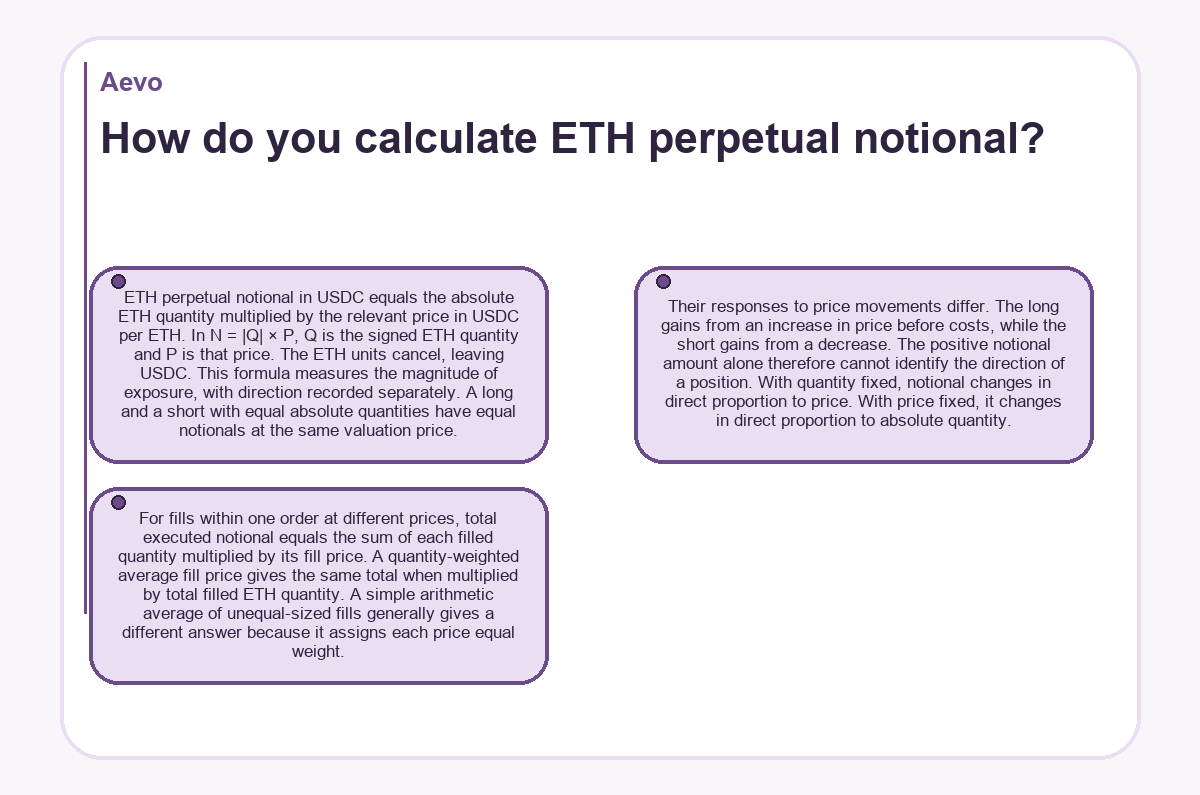
A long and a short with equal absolute quantities have equal notionals at the same valuation price. Their responses to price movements differ. The long gains from an increase in price before costs, while the short gains from a decrease. The positive notional amount alone therefore cannot identify the direction of a position.
With quantity fixed, notional changes in direct proportion to price. With price fixed, it changes in direct proportion to absolute quantity.
For fills within one order at different prices, total executed notional equals the sum of each filled quantity multiplied by its fill price. A quantity-weighted average fill price gives the same total when multiplied by total filled ETH quantity. A simple arithmetic average of unequal-sized fills generally gives a different answer because it assigns each price equal weight.
Limit, fill and mark prices
Limit prices value proposed orders, fill prices value executions and mark prices provide an open-position valuation basis. Those prices describe different things, even when their numerical values coincide. An order’s limit sets an execution constraint; it does not establish that the requested quantity has traded. The quantity and price used together must belong to the amount being measured.
| Price basis | Quantity used | USDC amount | Meaning and limit |
|---|---|---|---|
| Limit price | Requested order quantity in ETH | Quantity × limit price | Order value at its limit; execution remains unconfirmed. |
| Fill price | Quantity in that execution, in ETH | Filled quantity × fill price | Executed notional for that fill; excludes an unfilled remainder. |
| Mark price | Absolute open-position quantity in ETH | Position quantity × mark price | Valuation at the mark; does not promise an exit price. |
The mark price is a calculated reference, while a traded price records an execution. Available orders determine the prices at which a position can trade. A closing trade can therefore have a different executed notional from the position’s earlier valuation at the mark. A price’s label and measurement time help explain differences between an execution record and a position valuation.
Collateral and margin alongside notional
Collateral backs trading obligations, while notional measures exposure in quote units. A larger notional does not establish that the account contains the same amount of freely withdrawable USDC. It expresses the scale of the contract exposure at the selected price.
Initial margin determines the collateral required to establish a position. Maintenance margin concerns the equity required to keep it open. These requirements follow the applicable contract and account framework. Notional alone does not establish available trading capacity or a liquidation price, since neither calculation consists only of multiplying ETH quantity by price.
Changing leverage alone does not change notional when ETH quantity and price remain fixed.
Aevo’s single margin account supports options and perpetual positions together. The account’s obligations therefore need their applicable margin treatment. An individual ETH perpetual’s notional supplies that position’s reference value. Account equity, other obligations and the margin framework remain relevant to trading capacity. Exposure measured for one position cannot substitute for a calculation covering the whole account.
Price movement and trading profit
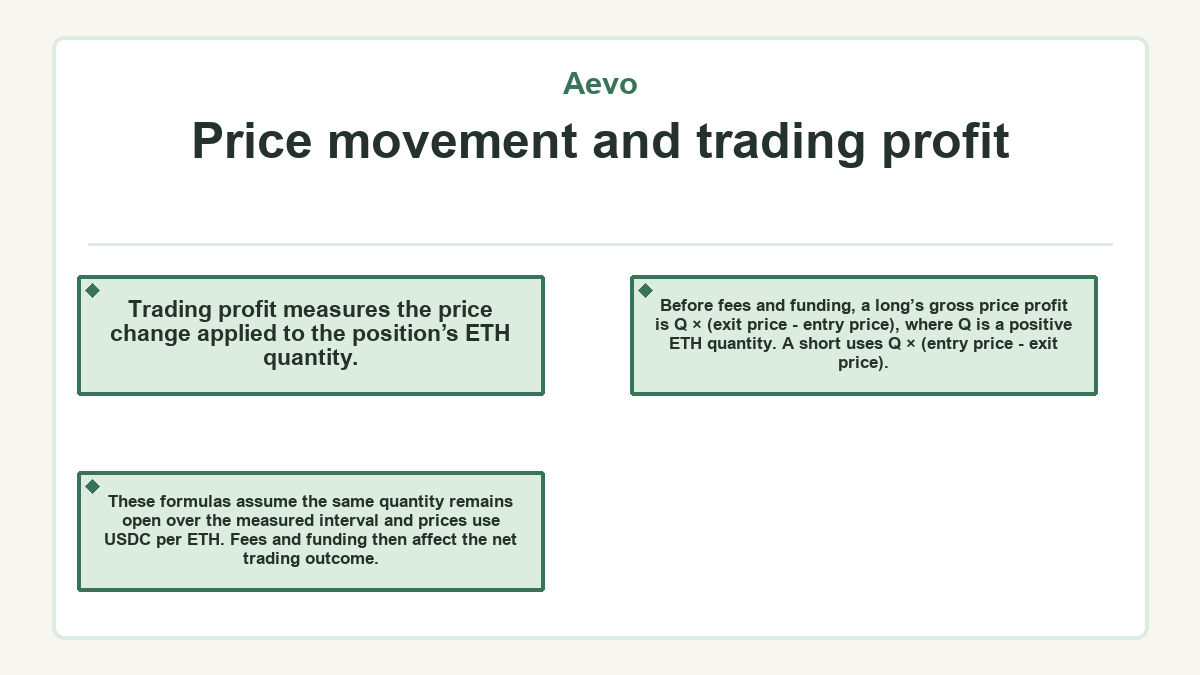
Trading profit measures the price change applied to the position’s ETH quantity. Before fees and funding, a long’s gross price profit is
Q × (exit price - entry price)
, where
Q
is a positive ETH quantity. A short uses
Q × (entry price - exit price)
. These formulas assume the same quantity remains open over the measured interval and prices use USDC per ETH. Fees and funding then affect the net trading outcome.
The ETH calculation’s product boundary
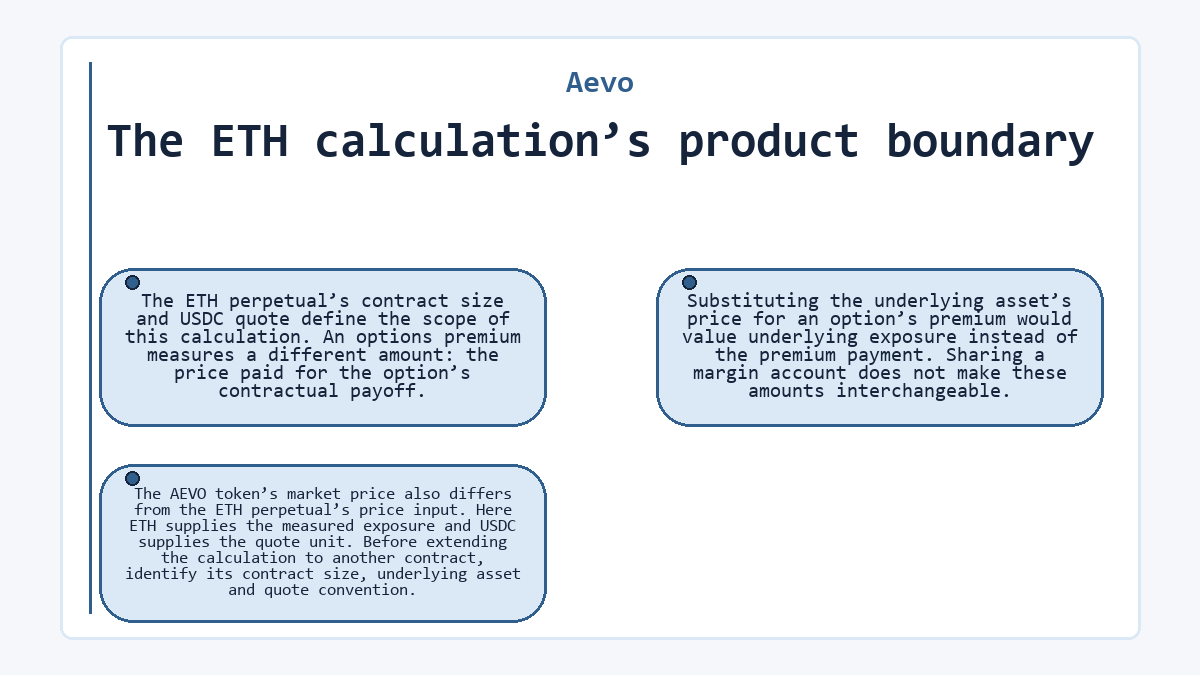
The ETH perpetual’s contract size and USDC quote define the scope of this calculation. An options premium measures a different amount: the price paid for the option’s contractual payoff. Substituting the underlying asset’s price for an option’s premium would value underlying exposure instead of the premium payment. Sharing a margin account does not make these amounts interchangeable.
The AEVO token’s market price also differs from the ETH perpetual’s price input. Here ETH supplies the measured exposure and USDC supplies the quote unit. Before extending the calculation to another contract, identify its contract size, underlying asset and quote convention.
Helpful answers about Aevo
Can ETH perpetual orders use fractional contract quantities?
ETH perpetual orders can use fractional quantities in increments of 0.01 ETH under the published contract specification. The 1 ETH contract size defines the exposure unit; it does not require whole-contract orders. Quantity increments and minimum order value impose separate conditions on an acceptable order.
Why can a correctly rounded ETH quantity still be too small for an order?
The ETH perpetual specification requires a minimum order value of 10 USDC. An order can satisfy the quantity increment while its USDC value remains below that minimum. Minimum order value and quantity precision impose separate requirements, so a correctly rounded quantity does not establish that the order is large enough.
Does the ETH price step determine how the final notional rounds?
The ETH perpetual’s price step of 0.01 USDC per ETH constrains the quoted price, not the precision of every monetary total. Multiplying a fractional quantity by a permitted price can produce additional decimal places. A calculation should retain that precision until the rounding rule for the particular total applies.
How can I derive the ETH quantity from a USDC notional?
Divide the USDC notional by the same USDC-per-ETH price used to calculate it. With a positive price, this gives the absolute ETH quantity for the ETH perpetual contract. Direction remains separate. Using a different valuation price produces a different inferred quantity, even when the quoted notional stays unchanged.
Do I own the ETH represented by an ETH perpetual position?
An ETH perpetual position gives contractual price exposure; its notional does not establish ownership of an equivalent ETH token balance. The contract’s 1 ETH size defines the exposure unit. Its USDC notional expresses that exposure’s value at the chosen price, without documenting a corresponding spot ETH holding.